This is a call for contributions to an open educational resource aimed at helping researchers, students, practitioners and educators learn about using creative and embodied methods in real-world research settings.
The organising committee of the World Conference in Qualitative Research invited me to deliver the closing keynote for their 10th Conference in Madrid in January 2026. The body in qualitative research: from disembodied knowledge to corporeal praxis...
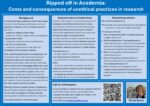
Call for participants! “Ripped off in Academia: Costs and Consequences of Unethical Practices in Research” Background In informal settings, academics of all career stages talk about being ripped off in higher education: they experience or...
Creativity has become a buzzword across all disciplines in education and across all phases, from early years through to tertiary education. Although the meaning of creativity can change vastly depending on the global educational setting, it is impossible...
In April 2024, I was asked to deliver a keynote for an international webinar organised by CripLab. CripLab is a research laboratory on crip posthumanities in Santiago, Chile, whose members seek to map the modes of discursive and material production of the...
I was asked to an “in conversation with REA”. The Research Ethics Association (REA) brings together academia, industry, and local organisations across all disciplines with the aim of promoting and implementing cross-discipline research ethics,...
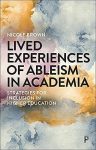
Deeply embedded in personal experiences, this perceptive book provides examples for universities to develop inclusive practices, accessible working and learning conditions and a less ableist environment.
This is a recording of my talk "Research ethics in a changing social sciences landscape" from the UCL Research Ethics Conference "Frontiers in Best Practice in Research Ethics" in September 2022.
This is a link to a webinar organised to offer support for students taking on research projects. My contribution was based on my book Making the Most of Your Research Journal.
I was invited to contribute to the ResDance Podcast. My contribution was about my Embodied Inquiry work, as part of my own research and as part of the Embodied Inquiry: Research Methods book.